Skip to content
Mesoscale Cell Biology Lab

Organisation is a measurable state.

Explore how concentration, variants and cellular context can alter organisation—without turning puncta into an automatic claim of phase separation or material state.

Research journey · 2019–2025

Selected dated research milestones.

Proposals, lab material, seminar work, preprints and publications listed chronologically.

  1. Volkswagen Foundation Experiment! proposal

    Phase separation as a foundational technology for synthetic biology and cellular engineering

    “Can phase separation be a novel bio-design module for synthetic biology?”

    Archival proposal · circulated 1 July 2019

  2. TRIM-family working model

    Consensus domain architecture & modularity of TRIM family ligases

    “TRIM/RBBC · Phase separation ?”

    “Mesoscale organization ? · Allosteric regulation ? · Emergent stickers ?”

    Archived working slides · 2020

    Volkswagen Foundation proposal

    Identification of TRIM family ubiquitin ligases that can restrict Corona virus: A condensate approach

    Proposal models included virus-triggered TRIM condensate formation and partitioning of viral proteins into preformed TRIM condensates.

    Hari R. Singh & Anthony A. Hyman · 2020

  3. Lab Meeting · 17 March 2021

    TRIM-family mesoscale organisation

    Lab-meeting material considered surface-assisted condensation and other candidate mechanisms for mesoscale organisation.

    Archived lab-meeting material · 17 March 2021

  4. CBG Seminar · 8 April 2022

    TRIM family proteins as a model for the mesoscale organisation of cells

    Seminar material included quantitative measurements of recovery, mobile fraction, enrichment, geometry and localisation.

    Hyman Lab · MPI-CBG · Dresden

  5. PICNIC · bioRxiv preprint · 5 June 2023

    PICNIC identifies condensate-forming proteins across organisms

    Experimental validation tested 24 positive predictions in cellulo.

    bioRxiv · 10.1101/2023.06.01.543229 ↗

  6. PICNIC · Nature Communications · 11 December 2024

    PICNIC accurately predicts condensate-forming proteins regardless of their structural disorder across organisms

    The publication reports the 24-protein positive validation and an additional validation set of 21 proteins predicted to be negative by PICNIC.

    Nature Communications · 2024 ↗

  7. TRIM-family mesoscale studies

    TRIM-family mesoscale landscape and family-scale condensation studies

    The TRIM landscape reports systematic mesoscale localisation across 72 human TRIM proteins. A separate Cell Reports study examined 75 TRIM proteins.

    TRIM landscape · bioRxiv · 2025 ↗ Cell Reports · 2025 ↗

Module 01 · concentration and context

Change the state before naming the mechanism.

This first module is an explanatory simulation. It establishes the reasoning interface that will later sit beside real microscopy and quantitative measurements.

Derived simulated state

Diffuse / weakly structured

Explanatory simulation · not experimental microscopy

Low-to-intermediate concentration produces a largely diffuse simulated distribution.

Boundary: a concentration-associated punctate transition is an organisational phenotype. It is not, by itself, proof of liquid–liquid phase separation, material state or biological function.
Mechanism hypothesis map

Describe the organisation first. Name the mechanism only after discrimination.

Mesoscale organisation is the umbrella phenotype. Liquid–liquid phase separation (LLPS) is one possible mechanism—not a synonym for the phenotype. Start from what is observed, then keep competing mechanism hypotheses alive until a measurement or perturbation separates them.

Observed organisation

Descriptive organisational states

  • diffuse
  • punctate / clustered
  • filamentous
  • networked
  • surface-associated layers
Candidate mechanism family

Bulk / 3D mechanisms

  • liquid–liquid phase separation (LLPS)
  • ordered cooperative assembly (OCA)
  • self-assembly
  • templated assembly
  • polymer-assisted organisation
  • scaffold-mediated assembly
  • coacervation
  • active assembly
Candidate mechanism family

Interface / surface mechanisms

  • surface-assisted organisation
  • adsorption
  • surface condensation
  • wetting
  • prewetting
  • adhesion
Discrimination rule: The same visible phenotype can arise from different mechanisms. Choose an observation or perturbation that makes competing mechanisms predict different outcomes before naming the mechanism.

Evidence boundary: Puncta do not establish a condensate; a condensate does not by itself establish LLPS; mesoscale organisation does not establish phase separation.

Mechanism discrimination instrument · VS-090

Make competing mechanisms predict different outcomes.

Start from a measured organisational state, keep at least two mechanism hypotheses alive, then choose a perturbation or observation that can separate them. The instrument compares teaching expectations; it never infers mechanism from morphology alone.

Start from the observed organisational state. Keep competing mechanism hypotheses alive until a measurement or perturbation separates them.

Hypothesis A

A · mechanism hypothesis

Choose two mechanisms and a discriminating test to expose different expectations.

Hypothesis B

B · mechanism hypothesis

No mechanism is inferred from morphology alone. The instrument does not infer mechanism from roundness, puncta or recovery alone.

Relative discrimination is not mechanism proof. A single perturbation can shift support between hypotheses, but mechanism requires convergent evidence, controls, replication and explicit alternatives. Morphology, fusion, roundness or FRAP recovery alone are not sufficient.

Mesoscale atlas · 10 investigations

Organisation is a phenotype; mechanism must be earned.

Move from image to quantitative state, then from state to mechanism and function. The cards stay closed until the question is useful.

Prediction rule: record the expected distribution—not the best-looking image—before changing concentration, context or protein state.
01
Define the organisational phenotypeWhat is actually measured when a cell looks diffuse, punctate, filamentous or networked?
Evidence to inspect
Object distributions across cells and fields: number, size, intensity, shape, connectivity, compartment and diffuse fraction.
What would falsify it
The phenotype disappears under a segmentation method that preserves known controls.
Primary confound
Threshold choice, focus, expression level or field selection creates the apparent class.
Highest-value next test
Pre-register segmentation and compare continuous distributions with blinded images and negative controls.
02
Map concentration responseHow does organisation change across endogenous and perturbed abundance?
Evidence to inspect
Calibrated abundance per cell, organisational metrics, time, cell state and the full response distribution.
What would falsify it
Organisation is independent of abundance within the biologically relevant range.
Primary confound
Reporter nonlinearity or selection of expressing cells creates an artificial threshold.
Highest-value next test
Measure endogenous or calibrated abundance and organisation in the same single cells.
03
Resolve stoichiometry and valencyWhich interaction multiplicities are required for collective organisation?
Evidence to inspect
Oligomeric state, binding-site number, partner ratios, domain architecture and concentration-dependent assembly.
What would falsify it
Matched perturbations that change valency do not shift organisation as predicted.
Primary confound
Mutation alters folding, localisation or abundance rather than interaction multiplicity.
Highest-value next test
Use modular valency variants with folding, expression and partner-occupancy controls.
04
Distinguish condensation from alternativesWhich observations separate phase separation from binding, polymerisation, aggregation or scaffold recruitment?
Evidence to inspect
Concentration scaling, exchange, reversibility, fusion, composition, perturbation response and orthogonal structural evidence.
What would falsify it
A simpler binding or scaffold model predicts the same held-out behaviour with fewer assumptions.
Primary confound
Rounded morphology or FRAP recovery is treated as diagnostic by itself.
Highest-value next test
Design one perturbation under which phase separation and the strongest alternative predict different outcomes.
05
Measure dynamics and material behaviourHow rapidly do components exchange, rearrange and recover?
Evidence to inspect
Time-resolved FRAP with model checks, single-particle tracking, fusion/relaxation, washout and repeated perturbation.
What would falsify it
Dynamics remain unchanged when the proposed material-state determinant is altered.
Primary confound
Bleaching geometry, transport, binding exchange or phototoxicity dominates the curve.
Highest-value next test
Combine recovery with independent mobility and reversibility measurements over matched timescales.
06
Measure composition and selectivityWhich molecules are enriched, excluded or conditionally recruited?
Evidence to inspect
Quantitative partitioning, stoichiometry, interaction controls, spatial nulls and perturbation-dependent composition.
What would falsify it
Recruitment follows bulk abundance or compartment volume rather than the proposed interface.
Primary confound
Spectral bleed-through, overexpression and common localisation inflate colocalisation.
Highest-value next test
Use calibrated enrichment plus interaction-deficient mutants and spatially matched null models.
07
Make context a variableHow do lineage, cell cycle, stress and compartment change the organisational rule?
Evidence to inspect
Direct context markers, matched perturbations, endogenous abundance, time course and context-by-perturbation interactions.
What would falsify it
The effect does not replicate when the proposed context variable is measured or manipulated directly.
Primary confound
Unmeasured batch, morphology or expression differences masquerade as biological context.
Highest-value next test
Perturb the context determinant while holding protein dosage and acquisition constant.
08
Establish variant mechanismDoes a disease-associated variant shift organisation through a specific molecular change?
Evidence to inspect
Isogenic genotype, dosage matching, folding, localisation, interaction state, dynamics, phenotype and mechanism-specific rescue.
What would falsify it
The organisational shift survives correction of the proposed molecular defect or follows expression alone.
Primary confound
Different protein stability or cellular stress produces a similar distribution.
Highest-value next test
Pair an isogenic variant with a separation-of-function rescue and orthogonal interaction readout.
09
Connect organisation to functionDoes changing mesoscale organisation alter a defined biological output?
Evidence to inspect
Acute organisation perturbation, target engagement, proximal mechanism, functional readout, dose/time relation and rescue.
What would falsify it
Organisation changes without the predicted functional consequence—or function changes while organisation is preserved.
Primary confound
The perturbation affects catalytic activity or stress independently of organisation.
Highest-value next test
Use an acute separation-of-function perturbation that changes organisation while preserving abundance and core activity.
10
Integrate a cross-scale modelWhich links are observed, inferred and still proposed from molecule to cell state?
Evidence to inspect
Evidence-class map, measured variables, transformations, uncertainty, alternative explanations and next discriminating experiment.
What would falsify it
A required link fails under orthogonal measurement or predicts the wrong held-out response.
Primary confound
A compelling diagram hides unmeasured transitions between scales.
Highest-value next test
Publish the model with evidence classes and test its weakest decision-critical link next.
Evidence in motion

Prediction and organisation, side by side.

Proteome-scale prediction

Features beyond disorder.

▶ Watch video
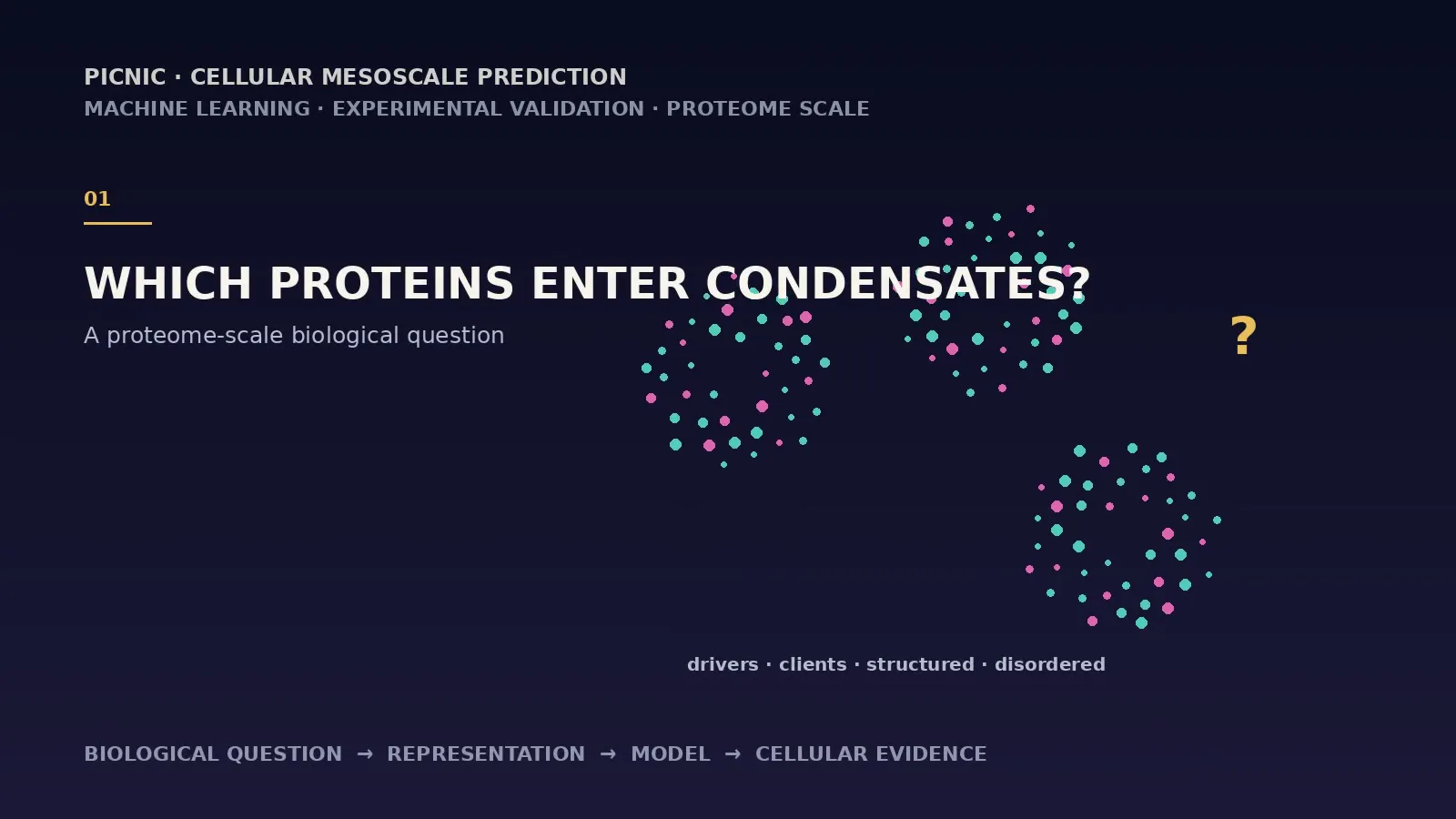
PICNIC connects sequence-derived features to proteome-scale condensate prediction. Developed with the Tóth-Petróczy Lab at MPI-CBG. Open TRIMCode context →
Scale in motion

What the mesoscale means.

▶ Watch video
The organisational scale between single molecules and whole cells, where concentration, context and collective behaviour decide cellular state.