Molecular & structural biology
Mechanistic cell biology, protein architecture, chromatin regulation, biochemical design and structure–function analysis.
- Molecular cloning
- Construct design
- Mutagenesis
- Protein regulation
Research scientist · Life sciences
Molecular Cell Biologist · Scientific Programme Builder · Bio × AI
I study how molecular mechanisms shape cellular organisation, and build experimental, quantitative and computational systems that make those relationships testable.
Scientific profile
Mechanistic discovery, quantitative cell biology and reusable research systems brought together through rigorous experimental and computational work.
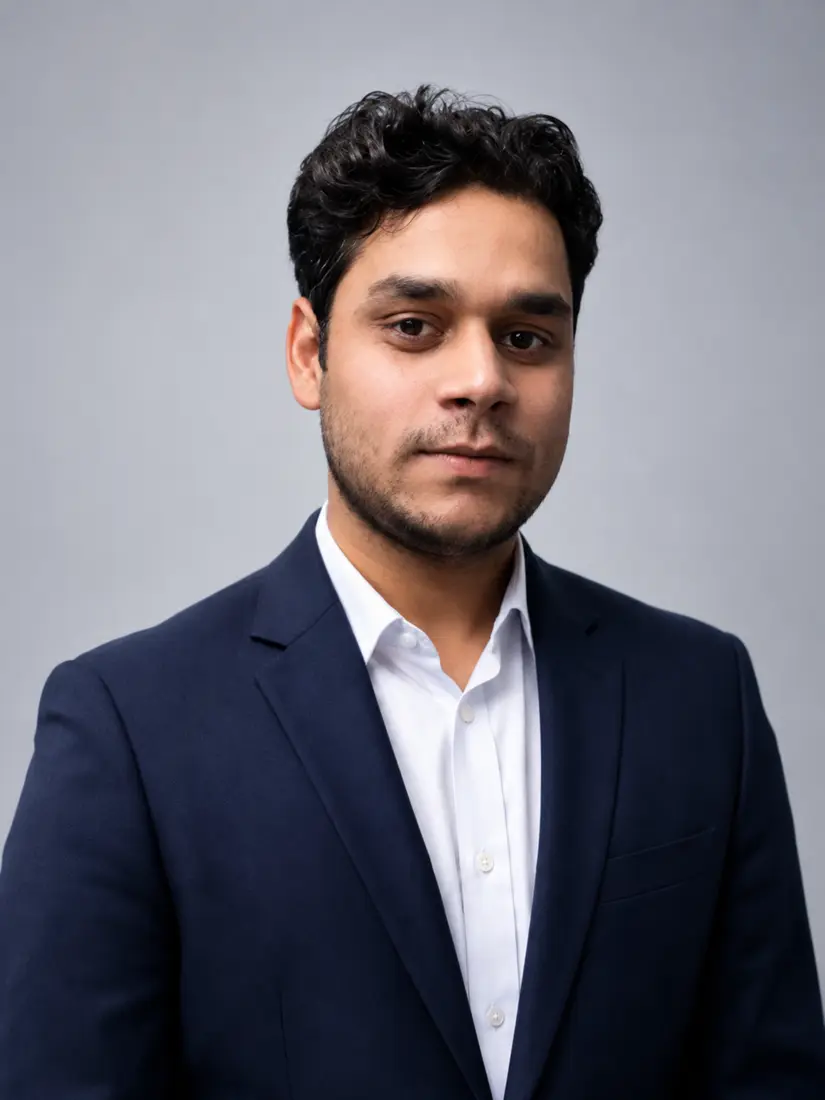
Hari Raj Singh is an interdisciplinary molecular and cellular biologist whose work connects mechanistic discovery, quantitative imaging, human genetics, mesoscale cellular organisation, AI-enabled prediction and scientific platform development. His record spans chromatin regulation, protein structure, TRIM-family biology, biomolecular condensates, nucleic-acid systems, scientific communication and evidence-aware research infrastructure.
Professional skills & expertise
Established research capabilities alongside recent Data Science & AI training, supported by publications, research platforms, programme work and the completed professional curriculum.
Mechanistic cell biology, protein architecture, chromatin regulation, biochemical design and structure–function analysis.
Live-cell fluorescence microscopy, high-content phenotyping, FRAP, cellular localisation, morphology and condensate dynamics.
TRIM-family experimental systems, biomolecular condensates, disease-associated variation and cellular mechanisms of TRIM8 syndrome.
Biological feature design and experimental validation in PICNIC, complemented by training in supervised learning, deep learning and model evaluation.
960 hours of Data Science & AI covering statistics, data preparation, visualisation, predictive models, time series, LLMs and AI agents.
Research-resource architecture, shared experimental controls, structured datasets, provenance, reproducible analysis and evidence-aware reporting.
ALC1's PARP-regulated chromatin-remodelling mechanism connects fundamental discovery to oncology-facing therapeutic hypotheses. Doctoral mentor Andreas Ladurner later founded Eisbach Bio.
Interdisciplinary programme design, experimental platform development, cross-institution coordination, mentoring, scientific writing and stakeholder engagement.
Research practice
Structure–function reasoning, construct and variant design, molecular cloning, targeted mutagenesis and mechanistic interpretation.
Live-cell fluorescence microscopy, high-content imaging, FRAP, localisation, morphology and mesoscale phenotype analysis.
Structured biological data, feature engineering, leakage-aware evaluation, multimodal integration and calibrated evidence reporting.
Reusable schemas, provenance, limitations and modular research systems connect observations with testable hypotheses.
Selected scientific and programme impact
Three examples connect biological questions to experimental systems, quantitative analysis and reusable evidence.
Opening this control reveals the Problem and Contribution statements in each Impact card while keeping the Impact evidence visible by default.
Research programme
TRIMCodeTRIMCode examines how molecular sequence and modular protein architecture shape cellular organisation through quantitative experiments, predictive models and reusable research tools.
Guiding questions
When does cooperativity explain mesoscale organisation?
When does condensation add explanatory power?
Opening this control reveals the three TRIMCode programme aims while the scientific thesis, guiding questions, evidence links and programme proof strip remain visible.
Resolve how changes in TRIM proteins reshape mesoscale organisation, molecular activity and cellular phenotype.
Connect protein architecture, interaction patterns, condensate dynamics and spatial behaviour across cellular contexts.
Combine structured experimental records, interpretable modelling and iterative validation into an evidence-aware framework.
Media & community
A short, original explainer on the organisational level between single molecules and whole cells that TRIMCode is built to study.
An MDR AKTUELL feature from Saxony on research at MPI-CBG, featuring Hari Raj Singh and Professor Anthony A. Hyman.
Source: MDR · Wirtschaft Wissen
22 Aug 2024 · 21:45
A short, original explainer tracing mesoscale organisation back to the molecular systems it emerges from.
Career
TRIM-family architecture and cellular organisation
Mesoscale Cell Biology framework
Bio × AI
Germany
neue fische / SPICED Academy
Completed 960 hours of Data Science & AI.
Topics: Python, statistics, machine learning, deep learning, time series, NLP, LLMs and AI agents.
Projects: exploratory data analysis, predictive modelling and collaborative capstone work.
Germany · Remote programme
Max Planck Institute of Molecular Cell Biology and Genetics
Professor · Tony Hyman · Director General, EMBL
Interdisciplinary programme building across molecular and cell biology, human genetics, quantitative imaging, computational analysis and translational disease research · TRIMCode · TRIM8 syndrome · PICNIC.
Dresden, Germany
Opening this control reveals four earlier scientific roles immediately below.
Technical University of Munich
Professor · Fritz Simmel · Chair of Physics of Synthetic Biological Systems, TUM
Intracellular information processing and recording systems.
Munich, Germany
Ludwig-Maximilians-Universität München
Professor · Andreas Ladurner · Physiological Chemistry, BMC, LMU
Founder · Eisbach Bio GmbH
Interdisciplinary doctoral research across molecular biology, structural biology, chromatin mechanisms and biophysics · ALC1 modular allostery and PARP-dependent activation · CRY1 structural biology · H3–NASP chromatin biology.
Munich, Germany
Jawaharlal Nehru Centre for Advanced Scientific Research
Professor · M. R. S. Rao · Former President, JNCASR
Chromatin dynamics, epigenetic regulation and stem cell biology.
Bengaluru, India
National Centre for Cell Science
Professor · Yogesh Shouche · Director, SKAN Research Trust
Founding Lead · National Centre for Microbial Resource · Former NCCS PI
Professor · W. N. Gade · Head, Department of Biotechnology · Former Vice-Chancellor, University of Pune
Microbial synthesis of silver nanoparticles and operon mapping in Morganella sp.
Pune, India
Education and development
960 hours of Data Science & AI
neue fische / SPICED Academy · Germany
Ludwig Maximilian University Munich · Germany
University of Pune / National Centre for Cell Science · India
Aligarh Muslim University · India
Opening this control reveals twelve training and scientific-exchange items immediately below.
16–18 December 2009 · CCMB · Hyderabad, India
30 August–5 September 2013 · Spetses, Greece
5–9 July 2015 · Taormina, Sicily, Italy
2–4 November 2017 · EMBL Heidelberg, Germany
28–30 April 2017 · Munich, Germany
14–15 November 2017 · LMU Munich, Germany
3–7 October 2022 · MPI-CBG, Dresden · Rob Phillips, Caltech
17–21 October 2022 · MPI-CBG, Dresden · Robert Haase
14–28 October 2024 · Cold Spring Harbor Laboratory, New York, USA
10–14 February 2025 · Multiscale Imaging Workshop · Tübingen, Germany
18–23 May 2025 · EMBO Workshop · TRIM-family condensatopathy presentation
8–11 July 2025 · Antwerp, Belgium · TRIM proteins and human condensatopathies
Publications and research outputs
The record spans chromatin regulation, structural biology, biomolecular condensates, human genetics, molecular bioengineering, scientific databases and predictive biology.
Single first author
Contribution
Mechanistic discovery connecting ADP-ribose signalling, chromatin remodelling, protein allostery and oncology.
Molecular Cell · 2017Co-first author
Contribution
Co-developed and experimentally anchored a predictive-biology framework with proteome-scale application and in-cell validation.
Nature Communications · 2024Co-first author
Contribution
Atlas-scale imaging and human-genetics research linking sequence variation, cellular phenotypes and condensatopathy.
bioRxiv · 2025Collaborative co-author
Contribution
Structural and mechanistic work connecting protein architecture, interactions and signalling function.
Cell · 2013Collaborative co-author
Contribution
Connects nucleic-acid chemistry, molecular computation, sensing and synthetic biology.
Chemical Reviews · 2019Collaborative co-author
Contribution
Protein-interaction and chromatin-assembly research linking sequence motifs to molecular recognition.
Nucleic Acids Research · 2016Collaborative co-author
Contribution
Integrates ADP-ribosylation, chromatin dynamics and DNA-damage-response mechanisms.
Frontiers in Bioscience · 2015Collaborative co-author
Contribution
Live-cell imaging and mechanistic chromatin biology linking molecular signalling to cellular structural change.
Molecular Biology of the Cell · 2016Collaborative co-author
Contribution
Transforms a machine-learning method into an accessible hypothesis-testing interface.
Bioinformatics · 2026 issue · online 2025Collaborative co-author
Contribution
Contributes to connected scientific-data infrastructure for condensate biology and translational hypothesis generation.
Nucleic Acids Research · 2026 issue · online 2025First author
Contribution
Commissioned-style scientific interpretation connecting structural mechanism to broader chromatin biology.
Nature Structural & Molecular Biology · 2017First author
Contribution
Concise mechanistic commentary on nucleosome organisation and remodeler regulation.
Molecular Cell · 2014First & corresponding author
Contribution
Scientific synthesis across gene regulation, condensate biology and reversible molecular control.
Trends in Genetics · 2019First & corresponding author
Contribution
Connects genome engineering, chromatin regulation, therapeutic possibility and explicit limitations.
Trends in Biochemical Sciences · 2018First & corresponding author
Contribution
Connects DNA nanotechnology, molecular sensing, oncology and responsible therapeutic engineering.
Trends in Molecular Medicine · 2018First & corresponding author
Contribution
Cross-domain commentary linking cancer metabolism, epigenetics and protein regulation.
Trends in Cancer · 2019Research translation
Hari Raj Singh's 2017 single-first-author study established how PAR releases ALC1 auto-inhibition, connecting protein allostery, chromatin remodelling and oncology. The published mechanism forms part of the scientific lineage of later ALC1-focused therapeutic development.
Open the Molecular Cell study ↗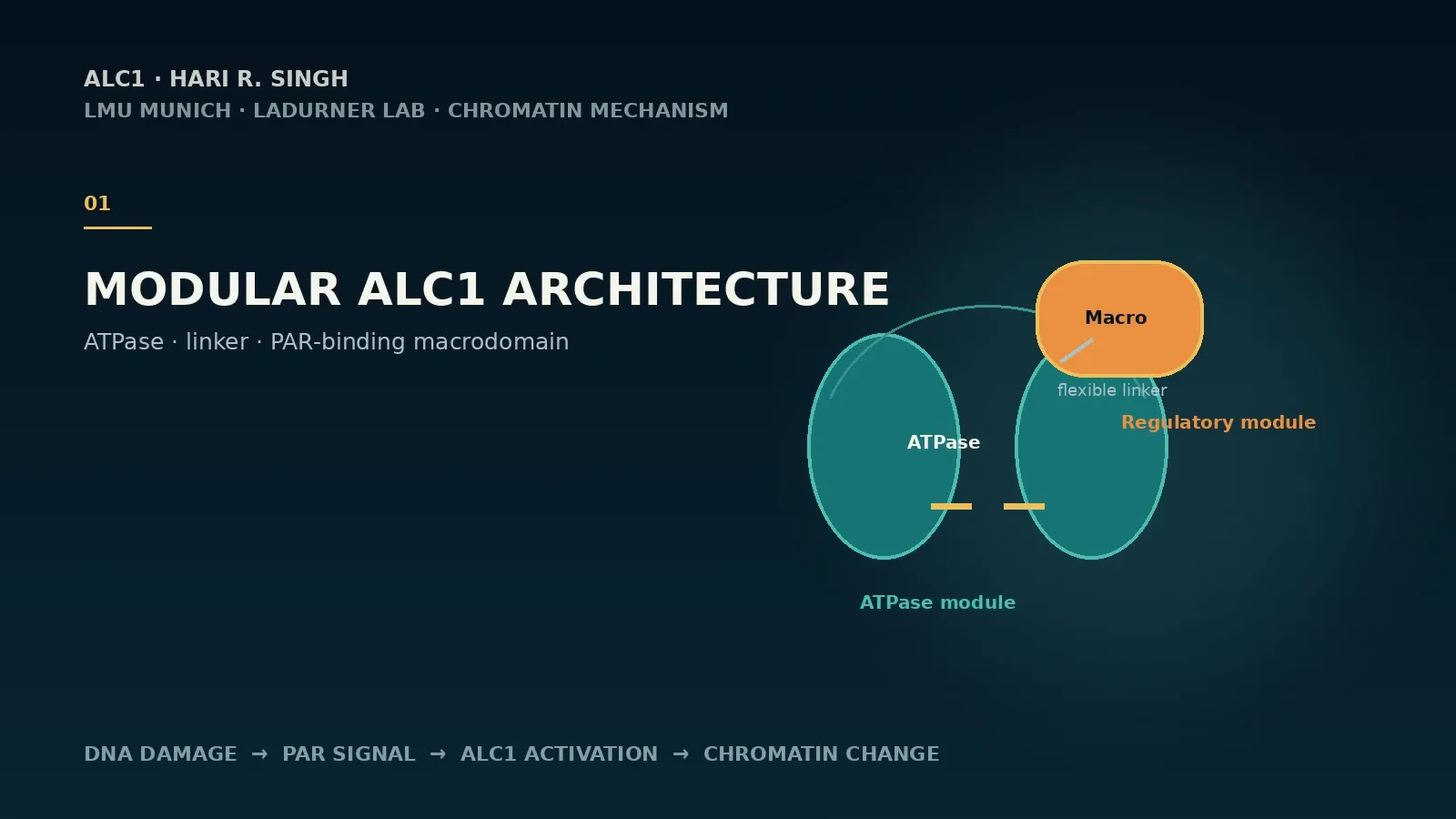 ▶ Watch video
Methods and capabilities
Molecular cloning, construct and variant design, targeted mutagenesis, mammalian cell culture, protein and nucleic-acid characterisation, biochemical and structure–function analysis.
Live-cell fluorescence microscopy, high-content imaging, FRAP, condensatography, image feature extraction, localisation and morphology phenotyping.
Python, structured data analysis, statistics, feature engineering, model evaluation and interpretation, multimodal integration, traceable metadata and analysis-ready datasets.
Experimental design, controls, reproducibility, protocols, evidence evaluation, scientific writing, interdisciplinary coordination and mentoring.
Scientific leadership & programme building
I build research environments in which experimental biology, quantitative analysis and computational methods work as one scientific system.
My leadership spans programme design, experimental-platform development, interdisciplinary coordination, mentoring, scientific communication and evidence-based decision-making.
Define research questions, decision points, milestones, dependencies and long-term scientific direction while keeping the biological problem central.
Evidence: TRIMCode programme architecture and reusable research frameworkCoordinate molecular biology, live-cell and high-content imaging, human genetics, quantitative analysis and external expertise; track progress and review technical risks.
Evidence: MPI-CBG experimental-platform delivery across TRIM, TRIM8 and PICNIC workMentor researchers, troubleshoot complex experimental projects and strengthen protocols, documentation, quantitative interpretation and reproducibility.
Evidence: research-led mentoring and platform troubleshooting across academic levelsConnect collaborators, disease communities, technology platforms and scientific outputs through clear stakeholder communication and evidence-aware decisions.
Evidence: human-genetics, cellular-phenotyping and predictive-biology collaborationsImaging-intensive workflows, shared experimental systems, technical-risk review and continuous scientific readiness.
Programme building and cross-functional delivery shown through linked publications, methods, platforms and research outputs.
Contact
I welcome conversations across experimental biology, quantitative imaging, scientific programmes, publishing and communication, research platforms and Bio × AI—where careful evidence and ambitious questions can lead to useful work.
Report a correction, missing method, navigation problem or accessibility issue →