TRIM protein architecture
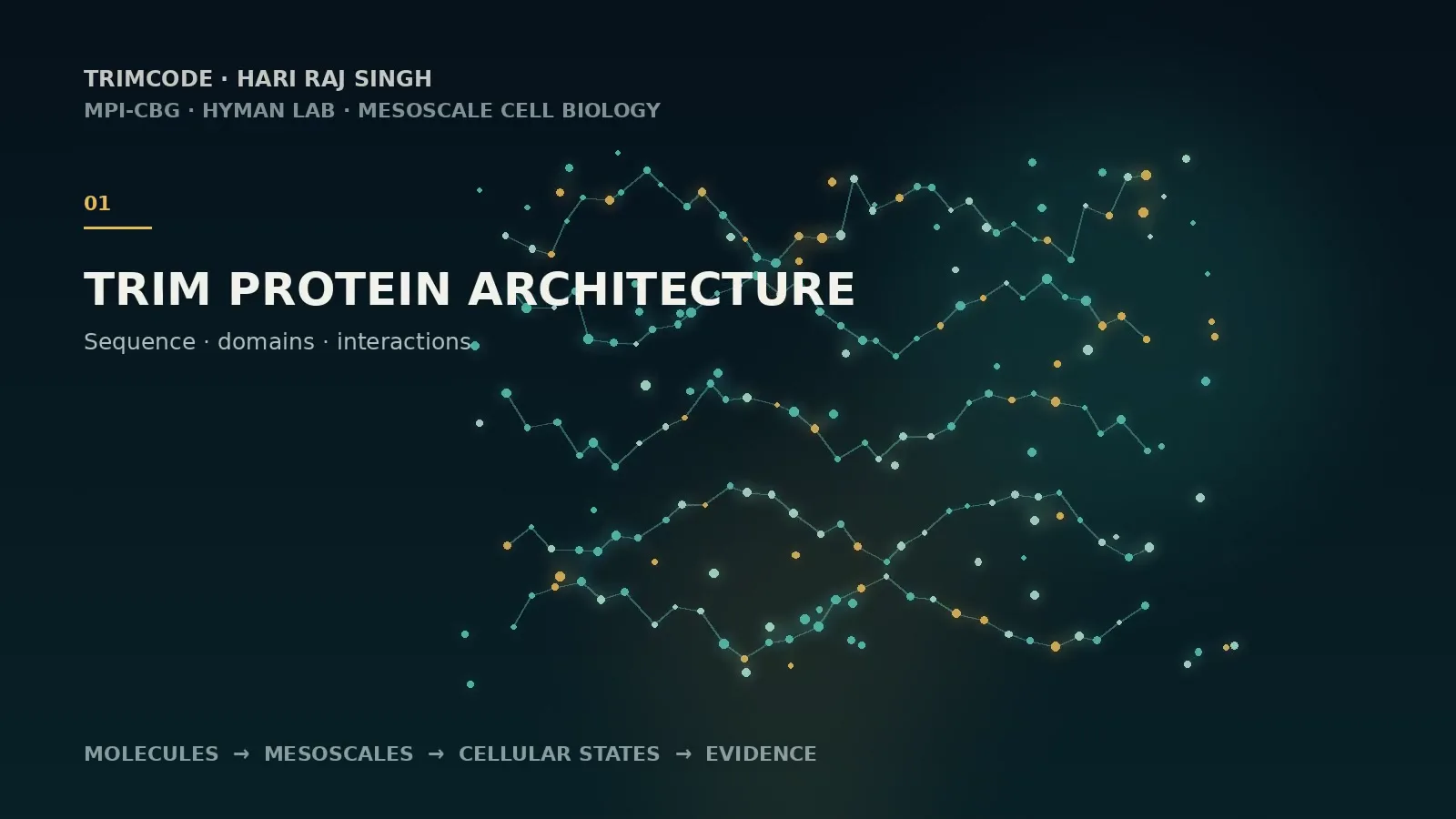
Sequence, domains and interactions — the modular architecture TRIMCode connects to cellular organisation and, downstream, to predictive modelling.
EXPERIMENTAL BIOLOGY · QUANTITATIVE IMAGING · EVIDENCE-GROUNDED AI
I connect experimental cell biology, quantitative imaging and computational modelling to investigate biological organisation, predict cellular behaviour and build traceable scientific platforms.
My work spans biological feature design, prospective validation, multimodal evidence integration and human-guided interpretation—keeping models accountable to biological evidence.
Models, validation, ensembles
Explore →Query relational data interactively
Explore →Animated flow visualisation
50 interactive experiments in classical machine learning
Explore →20 interactive experiments in representation learning & neural systems
Explore →From laptop to production, global scale & AI infrastructure
Explore →RAG, MCP, A2A, tools, evaluation and evidence-grounded orchestration.
Explore →Shared RAG concepts, Python examples, provenance and evidence boundaries.
Explore →Evidence-focused charts, uncertainty, annotation and visual reasoning.
Explore →PCA, clustering, nonlinear maps and anomaly detection.
Explore →Agents, value, policy, safety and bounded decision-making.
Explore →Representation, retrieval, reasoning, evaluation and responsible AI for biological knowledge systems.
Explore →Temporal structure, diagnostics, baselines, uncertainty and decision boundaries.
Explore →Labels, baselines, base rates and prediction boundaries.
Explore →When a live model stops being valid, and how you would know.
Explore →Leakage, split design and scores that mean what they say.
Explore →Randomisation, peeking, confounding and what a test cannot tell you.
Explore →What a 0.9 claims, where a threshold comes from, and when to withhold a number.
Explore →TRIMCode & predictive frameworks
Sequence, domains and interactions — the modular architecture TRIMCode connects to cellular organisation and, downstream, to predictive modelling.
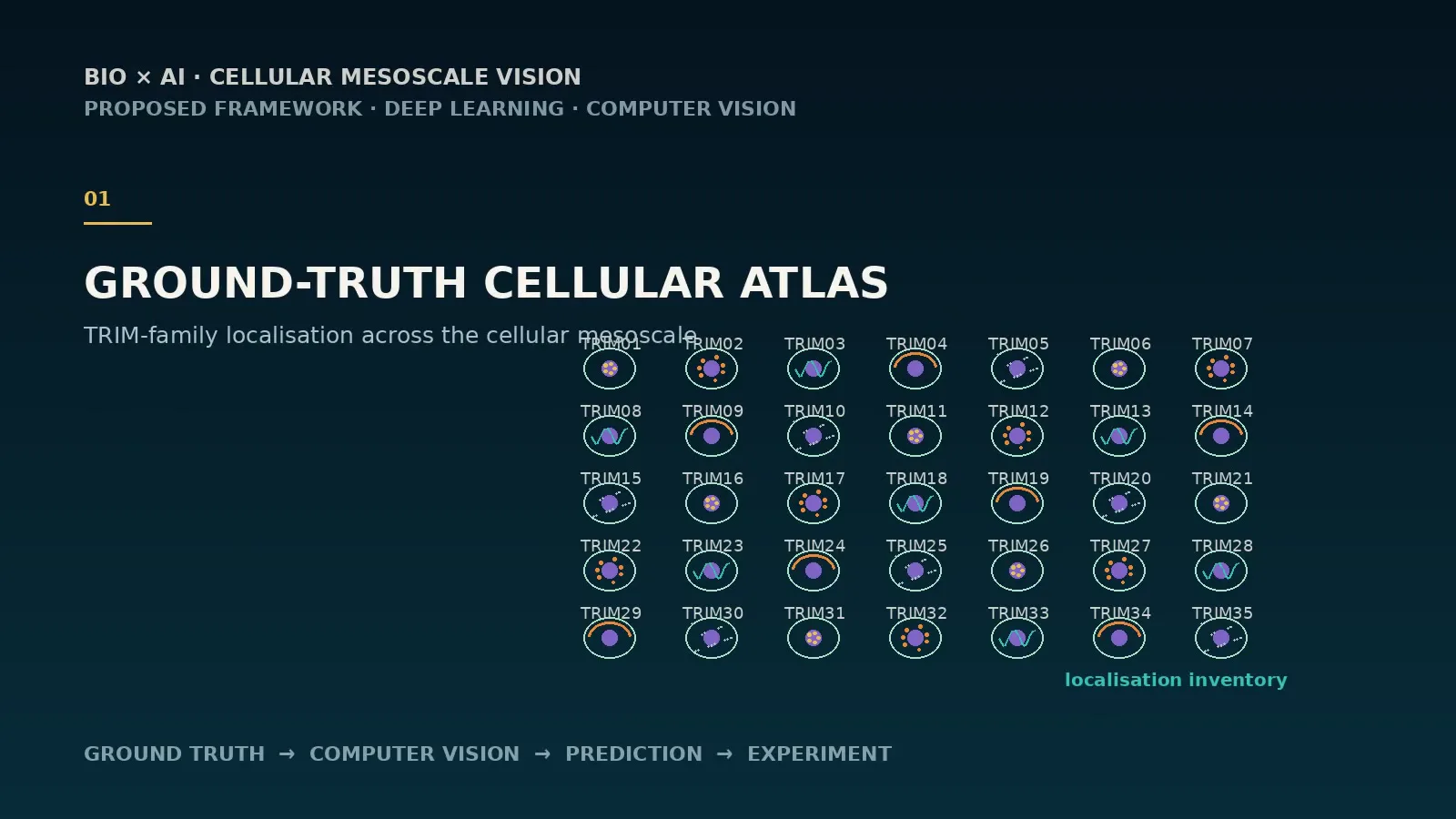
A proposed computer-vision framework converting microscopy into analysis-ready masks — reference annotations, predictions and experiments kept explicitly distinct.
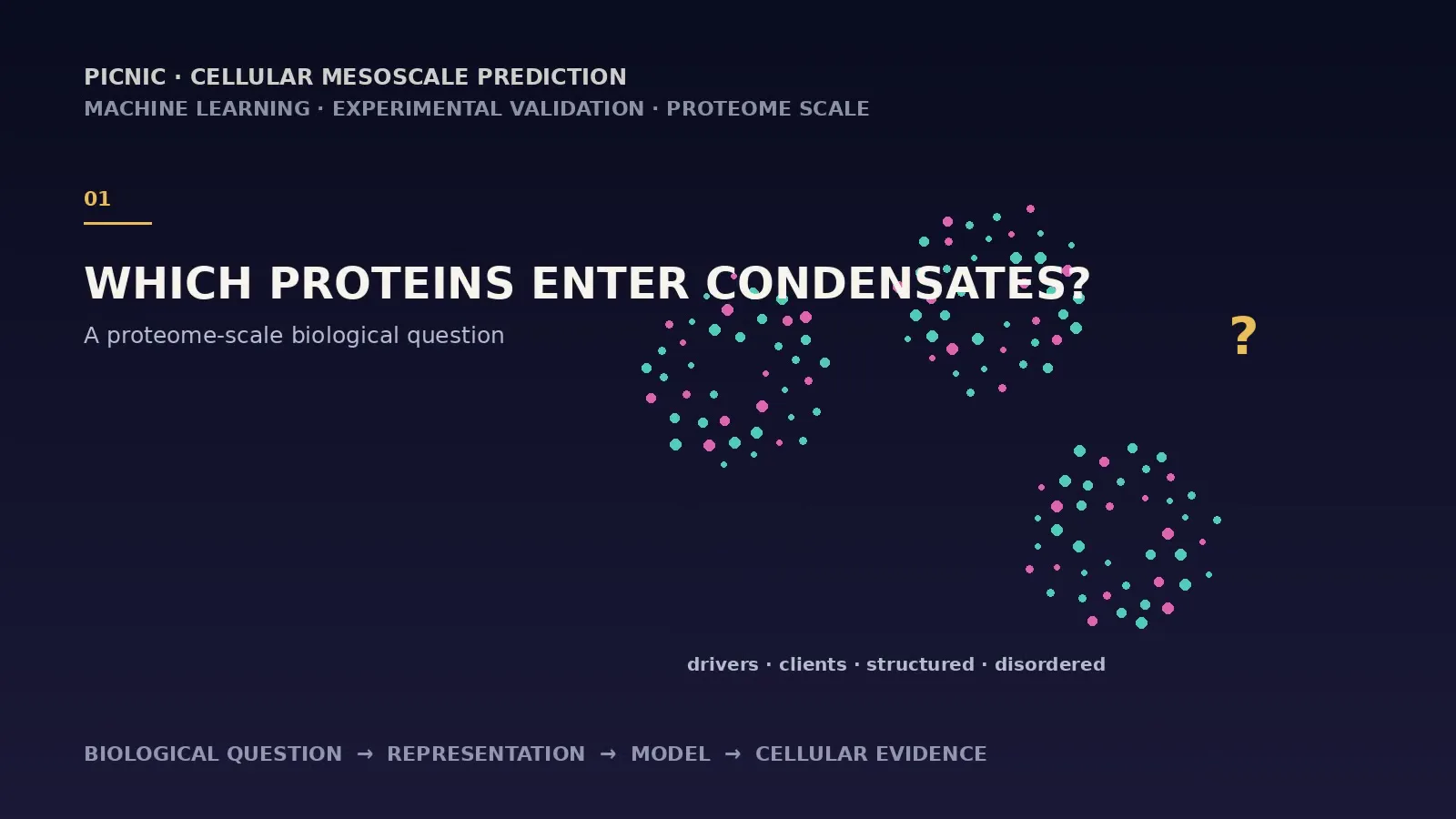
Sequence, predicted structure and disorder combined into a proteome-scale prediction of condensate-forming proteins, validated against cellular evidence. Developed with the Tóth-Petróczy lab, MPI-CBG.
The open question connecting sequence-level features to condensate-forming behaviour — the boundary this Bio × AI work, with the Tóth-Petróczy lab at MPI-CBG, is testing against cellular evidence.
Organising TRIM-family architecture, interactions and functional evidence.
Explore →Chromatin dynamics, perturbation & nuclear state
Explore →Mechanism, organisation, state & evolution
Explore →Oscillators, pulses, perturbation kinetics, hidden states and evidence boundaries.
Explore →Measurement strategies spanning molecules, assemblies, cells, tissues and organisms.
Explore →Disease mechanisms, biomarker evidence and testable therapeutic hypotheses.
Explore →Assemblies, condensates and spatial organisation between molecular and cellular scales.
Explore →Structure, interactions, kinetics and perturbations translated into testable mechanisms.
Explore →Preclinical evidence, patient stratification, biomarkers and therapeutic decisions.
Explore →Clear evidence, decisions, collaboration and communication across scientific work.
Explore →How biological systems encode, transmit, transform and retain information.
Explore →Transitions, memory, feedback and constraints across interacting biological scales.
Explore →Emerging initiatives
Models and interfaces for understanding how biological systems respond, recover and change state.
Assistive systems for evidence synthesis, experimental planning and reproducible analysis.
Structured retrieval and reasoning across literature, mechanisms and biological evidence.
Connected systems for organising biological measurements, relationships and multiscale data.
Evidence structures connecting disease biology, biomarkers and therapeutic hypotheses.
Exploratory tools that make biological data, models and scientific decisions inspectable.
Multidisciplinary life sciences
Designing, testing and translating biological mechanisms into engineered living systems and useful biotechnology.
Revealing structure, dynamics, energy and interaction through physical principles, chemical reasoning and multiscale measurement.
Turning quantitative and imaging-derived observations into models, software, AI systems and engineered tools that generate testable scientific decisions.
Highlights
For resilient environments and a livable future.
Open highlight → Sustainable prosperityBiological innovation for sustainable prosperity.
Open highlight → Dignity & accessScience and systems in service of human dignity.
Open highlight → Personal archive · 2017The thread connecting these directions, preserved as first published.
Open the full page →