Research across scales
Map Connect Build
Connecting molecular mechanisms,
cellular organisation, predictive biology and the Living Function.
The organising idea
One living system.
Many consequential scales.
No scale is merely background. Atomic contacts constrain proteins; proteins organise cellular states; cells build organisms; organisms reshape environments.
What changes, what persists and what becomes possible?
A shared evidence grammar
Scale changes the instrument—not the standard of proof
Structure & interface
Map contacts, conformations and molecular recognition.
Å → nmOrganisation & dynamics
Measure localisation, assemblies and transitions in living cells.
nm → µmState & function
Challenge a system, trace consequences and test rescue.
cell → organismModels & decisions
Connect heterogeneous evidence without hiding uncertainty.
dataset → ecosystemCartography across scale
From molecular state to cellular behaviour
Molecular changes reshape cellular organisation—and cellular organisation shapes function.
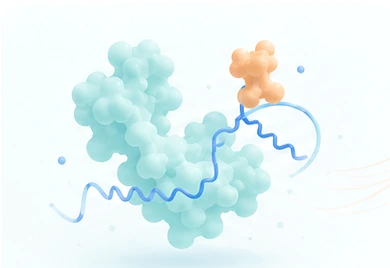
01
Molecular state
→
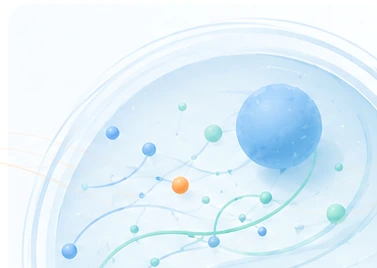
02
Mesoscale organisation
→
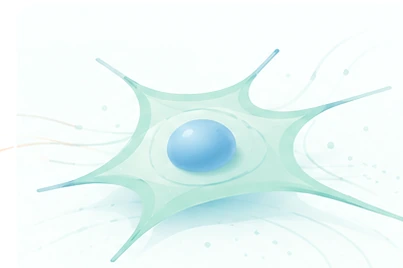
03
Cell behaviour
Mechanistic cell biology
Mesoscale organisation
Quantitative bioimaging
Human genetics
Predictive biology & AI
Molecular bioengineering
Molecular recognition · circadian biology
Partner choice becomes biological time
Cryptochrome interfaces organise competition between regulatory partners, coupling atomic recognition to protein turnover and circadian control.
Recognise
A defined molecular surface distinguishes competing partners.
Commit
Partner occupancy changes the regulatory state of CRY1.
Turn over
Ubiquitin-dependent control reshapes protein lifetime.
Keep time
Molecular kinetics propagate into a cellular rhythm.
Structural biochemistry · protein regulation · circadian systemsOpen publication record →
Molecular recognition · chromatin
Distributed contacts create precise recognition
The sNASP–histone H3 system shows how several individually modest contacts combine into a selective, biologically useful binding mode.
CHAPERONEsNASPstructured surface
CLIENTHistone H3distributed motifs
Molecular mechanism
PAR releases ALC1 autoinhibition
Tri-ADP-ribose recognition releases autoinhibition and activates ATP-dependent chromatin remodelling.
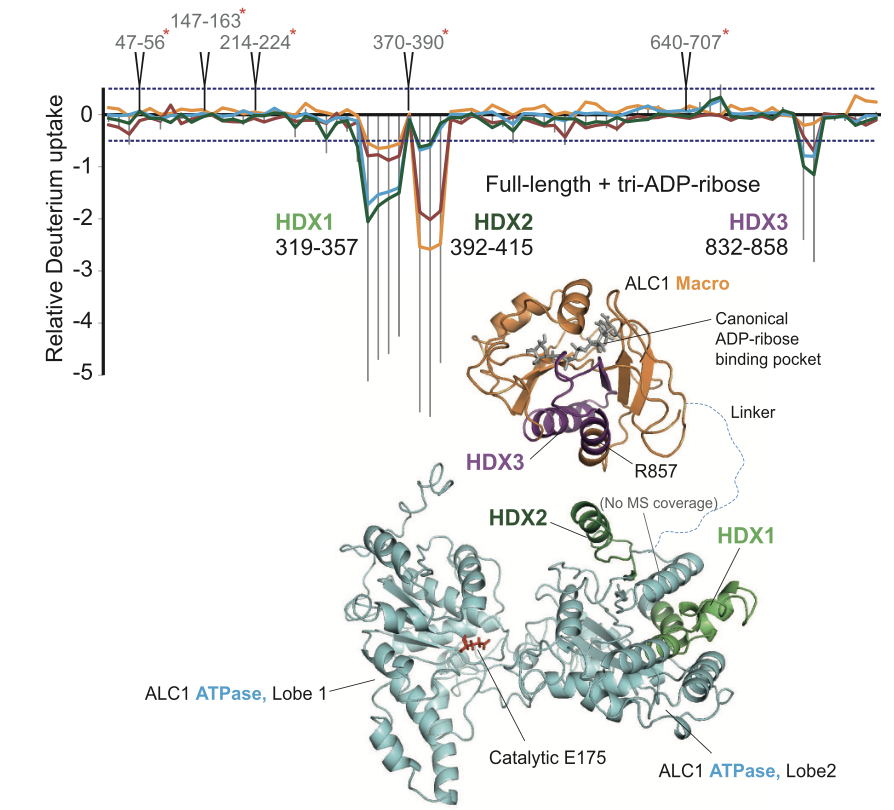
PAR binding + localisation
↓
Protein-state change
Modular allostery
↓
Chromatin dynamics
DNA-dependent ATP hydrolysis + remodelling
Molecular mechanism · video
Watch: ALC1 auto-inhibition
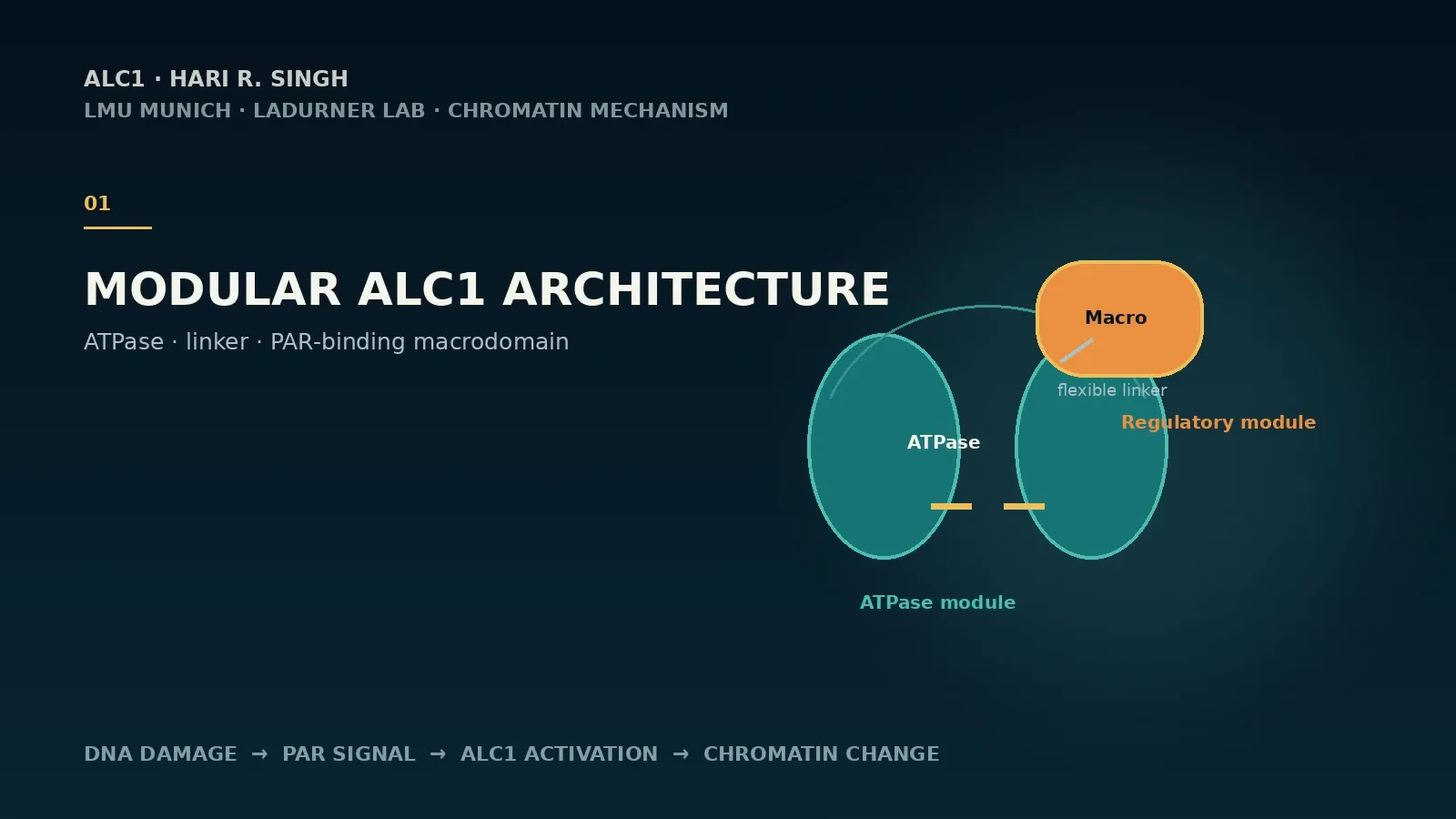
Modular ALC1 architecture — how tri-ADP-ribose recognition releases autoinhibition and activates chromatin remodelling.
Family-scale mechanism
A modular protein family encodes organisational diversity
Seventy-five human TRIM proteins combine a conserved catalytic scaffold with divergent interaction modules—an unusually rich model for linking molecular architecture to cellular organisation.
RINGB-boxCoiled-coil
×
PRY/SPRYPHD/BROMOCOS/FN3disordered regions
Family-scale mechanism · video
Watch: cellular mesoscale
Bodies, filaments, membranes and nuclear foci — how TRIM-family architecture connects to cellular organisation.
Research programme
TRIMCode decodes how protein architecture becomes cellular organisation
A whole-family programme connecting sequence, modular domains, interaction logic, mesoscale state, disease-associated variants and predictive research tools.
01 Organisation, function and disease
02 Quantitative organising principles
03 Predictive and engineerable tools
Open TRIMCode programme →
The mesoscale problem
Between molecules and cells lies an organisational scale
Complexes, condensates, filaments, organelles and membrane domains transform molecular interactions into spatially organised cellular behaviour.
contacts · domains · complexes
assemblies · bodies · interfaces · dynamics
state · polarity · physiology
What molecular features encode a compartment?How many organisational states can one family produce?When does organisation become pathology?
Mechanisms of localisation
Cells reuse a small grammar of organisational interfaces
A localisation atlas becomes mechanistic when every pattern is treated as a testable interface hypothesis.
Disease biology
TRIM8 variants expose an organisational defect
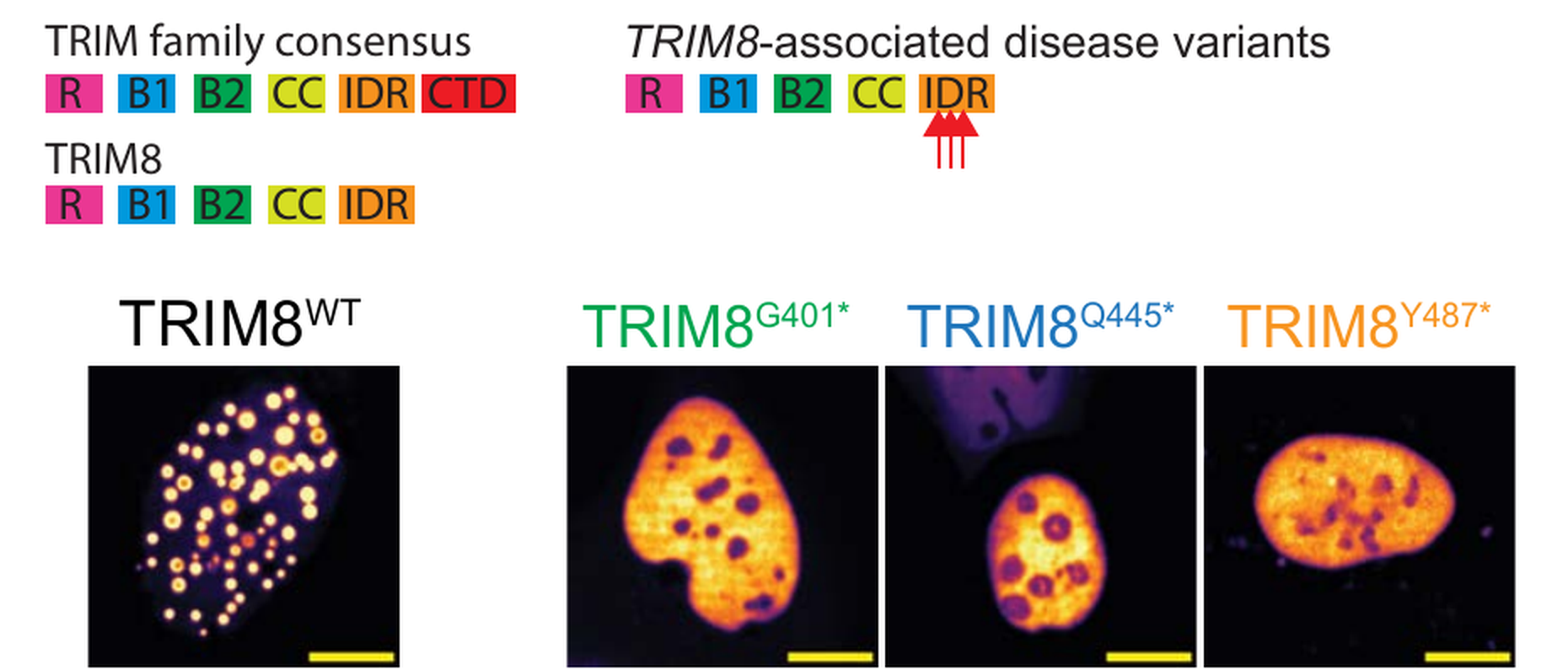 Scale bar 10 µm
Observed
WT forms organised nuclear puncta.
Variant effect
Truncations disrupt the organised state.
Disease biology · video
Watch: TRIM8 syndrome
Nephrotic & neurological disease biology
Majmundar Lab, Boston Children's Hospital
Experimental practice
Built through molecular scale
Design, make, measure and interpret—across constructs, proteins and living cells.
>2,000
DNA and plasmid constructs designed and generated
>200
unique protein identities worked with experimentally
Variants, fragments and fusion constructs extend beyond the protein-identity count.
Quantitative cellular organisation
TRIM8 nuclear bodies are measurable states—not visual anecdotes
A mesoscale claim becomes stronger when morphology, enrichment, exchange and abundance are quantified together.
Mesoscale certificateidentity + boundary + dynamics + enrichment + reproducible cellular context
Complementation rescues mesoscale organisation
RB1B2CCIDR
TRIM1-RBBC–TRIM8 IDR
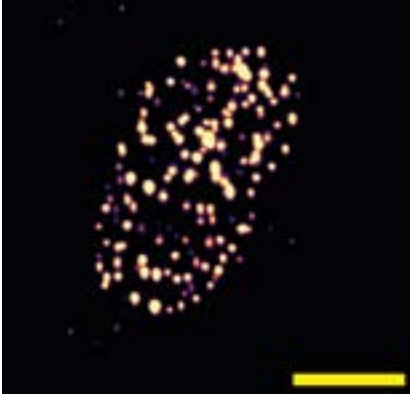
RB1B2CCIDR
TRIM8-RBBC–FUS IDR
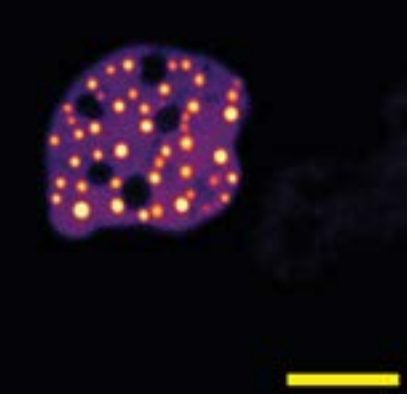
Singh HR et al. · bioRxiv · 2025 ↗
Scale bar 10 µm
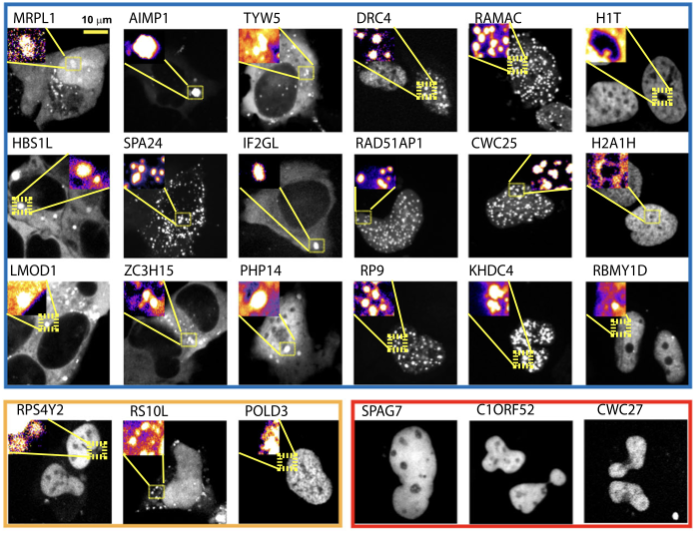
TRIM atlas · U2OS
Map the family in one cellular context
Scale bar 10 µm
Nuclear bodies
TRIM atlas · HeLa
Test which organisational states persist across context
Scale bar 10 µm
Nuclear bodies
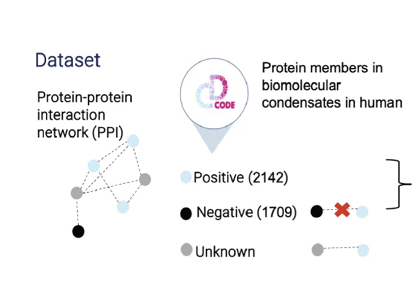
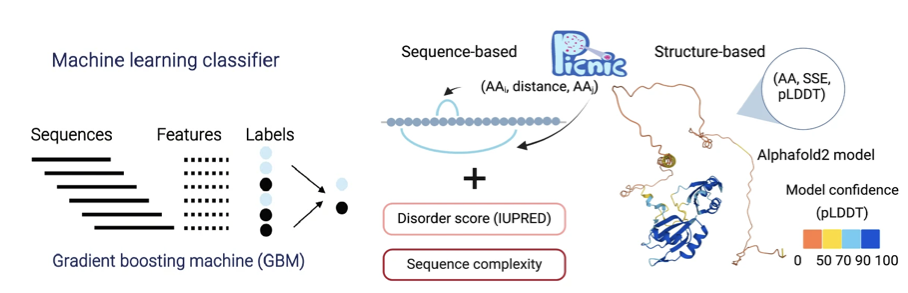
PICNIC predicts condensate-forming proteins
→
→
Cellular systems science
Mechanism, measurement and modelling converge on cellular state
Mechanism
variants · domains · perturbation
Measurement
localisation · organisation · dynamics
Modelling
prediction · calibration · testing
Cellular statethe shared object of evidence
Multiscale engineering
Engineering biology across scale
Every scale changes the question. The evidence stays connected.
DNA + RNA
design · sequence · expression
Proteins
interfaces · variants · domains
Mesoscale
assemblies · condensates · localisation
Cells
state · response · function
construct → perturbation → measurement → state → function
Cross-case synthesis
Across mechanisms, interfaces decide biological state
Autoinhibition becomes activation
PAR-dependent recognition releases a chromatin-remodelling state.
Partner choice shapes turnover
Selective interfaces organise competition between regulatory partners.
Multiple contacts create specificity
Distributed recognition stabilises a precise histone-binding mode.
Perturbation and rescue
Observation becomes evidence when the system is challenged
Variants, controlled perturbations and complementation expose causal structure.
Build contrast
wild type · variant · domain swap
Challenge
damage · depletion · recruitment
Measure
localisation · dynamics · organisation
Test rescue
complementation · function · boundary
Interactive biology
Interactive biology laboratories
Four connected working surfaces reuse one reasoning loop across molecular mechanism, mesoscale organisation, family-scale cartography and translational decisions.
01 · MOLECULAR
Molecular Mechanisms
Manipulate interfaces, domains, polymer state and molecular context.
Open lab → 02 · MESOSCALEMesoscale Cell Biology
Explore concentration, variants, dynamics and synthetic rescue.
Open lab → 03 · FAMILYTRIMCode
Move from individual proteins to whole-family systems cartography.
Open programme → 04 · DECISIONTranslational Biology
Turn heterogeneous evidence into explicit, revisable decisions.
Open lab →Shared grammarquestion → perturbation → evidence → boundary → decision → next experiment
State, memory and adaptation
The nucleus is a dynamic decision environment
Chromatin state, spatial organisation and molecular traffic jointly determine how cells remember, adapt and recover after perturbation.
From mechanism to decision
Disease biology needs connected evidence, not isolated biomarkers
Variants, molecular mechanisms, cellular states and patient context form an evidence chain. Translation fails when any link is assumed rather than tested.
Boundary: a mechanistic association is not yet a clinical decision rule.
Open Translational Biology Framework →Publications and research outputs
Sixteen outputs form one connected evidence record
Research articles, reviews, AI tools, data platforms and scientific commentaries connect structural mechanism with cellular organisation, genetics, engineering and prediction.
MECHANISMChromatin regulationALC1 · sNASP · molecular recognition
STRUCTURETemporal regulationcryptochrome · partner selection · turnover
ORGANISATIONMesoscale cell biologyTRIM proteins · variants · dynamics
PREDICTIONAI-enabled biologyPICNIC · data platforms · evidence systems
16 linked outputsEvery public claim remains attached to a stable publisher record and a stated contribution.Open the complete record →
Scientific journey · 2007 → present
From experimental science to imaging-platform and multiscale programme leadership
Current practiceMolecular Cell Biologist · Imaging & Scientific Programme Lead · AI-enabled BiologyOpen career and education →
Multidisciplinary life sciences
Life science becomes synthetic when disciplines work together
Build living systems
Synthetic biology · Biotechnology · Molecular engineering · Cellular engineering
Reveal physical rules
Physics · Chemistry · Biophysics · Quantitative microscopy
Turn evidence into models
Mathematics · Statistics · Computational science · Data engineering · AI
Bio × AI
Biology and computation form a feedback loop
Perturb · measure · validate
Experiments define the reality a model must explain.
↔iterate
Represent · model · challenge
Models compress evidence and generate the next test.
Scientific programme · 2021 → future
Towards an AI-enabled cellular mesoscale atlas
Algorithmic cellular cartography can convert image collections into testable inventories of organisational state—while keeping human judgement, biological context and uncertainty visible.
Mechanistic cellular cartographyinventory is the beginning; explanation is the goal
Visual intelligence observatory
One evidence field. Four ways to think.
The view changes; the scientific state does not. Switch lenses to see how estimate, uncertainty, structure and change generate different questions from the same evidence.
LENS 01 · ESTIMATE
Compare location before interpretation.
The point gives a position; the interval keeps the comparison honest.
Visual reasoning contractshared semantics · explicit support · uncertainty intact · identity preservedOpen Data Visualization Lab →Sankey Motion Pictures →
Learning by building
Interactive laboratories turn methods into inspectable practice
Each lab moves from a scientific question to a working computation, a reasoning boundary and a Python companion.
01Supervised MLprediction + evidence
02Unsupervised learningstructure + discovery
03Deep Learningrepresentations + boundaries
04Interactive ML50 working experiments
05SQL Playgroundrelational investigation
06AI Agentsbounded scientific workflows
07Infrastructure Atlas43 system decisions
08Reinforcement Learningactions + consequences
Teaching, mentoring and scientific leadership
Capability grows when reasoning becomes inspectable
Research-led leadership joins experimental design, platform troubleshooting, quantitative interpretation and scientific writing with reproducible computational practice.
Teaching & mentoring
Mentoring across academic levels · experimental design · troubleshooting · scientific writing
Learning architecture
Project-based · inclusive · milestone-driven · mechanistic · reproducibility-aware
Programme development
Formal modules · workshops · scientific-data training · evidence and AI literacy
Scientific programme deliveryCross-functional coordinationImaging-platform developmentEvidence-aware communication
Time, causality and scientific boundaries
Living function is a trajectory—not a snapshot
Biological rhythms, cross-scale feedback and human-gated workflows extend the portfolio from static prediction to changing systems.
TIME SERIES
Biological Rhythms
Separate recurrence, drift, intervention and uncertainty.
Open → CROSS-SCALE MODELLiving Function
Connect molecular events to tissue and organism-level consequences.
Open → EVIDENCE SYSTEMReference Library
Keep claims attached to public sources and scientific boundaries.
Open →Scientific apps
Apps make evidence explorable
The portfolio keeps its interactive instruments—and opens a path into computational work.
Beyond the cell
The multiscale paradigm extends to landscapes and ecosystems
The same habits—define state, expose interactions, model constraints and test consequences—can connect molecular science with resource systems, climate, infrastructure and ecological resilience.
Nested scalesBidirectional causalityShared constraintsHuman decisions inside the system
Science in society
Living systems sit inside ecological, economic and human systems
The portfolio remains research-led while recognising three wider contexts that shape which questions matter, who benefits and how scientific systems should be built.
Resilience across landscapes
Water, energy, biodiversity, microclimates and infrastructure as connected adaptive systems.
Biology translated responsibly
Biotechnology, materials, health and production systems evaluated through value and evidence.
People remain inside the model
Access, participation, livelihoods, accountability and the distribution of risks and benefits.
Multiscale is also socialwho gains · who carries risk · whose evidence counts · who participates in decisionsOpen broader themes →
Research presentations · living archive
Ideas evolve through talks, decks and working models
This portfolio keeps the argument—not a pile of files. Each presentation becomes a dated waypoint in an expanding scientific programme.
TRIM family proteins as a model for the mesoscale organisation of cells
From modular protein architecture and TRIM8 nuclear bodies to an AI-enabled cellular mesoscale atlas.
Hyman Lab · MPI-CBGEngineering Multiscale Physiology & Disease
Molecular architecture, cellular organisation, physiology and disease in one connected view.
Open presentation →Future presentations
New uploads will join the chronology and contribute selected concepts to the main multiscale story.
Designed for continued expansionFuture research programme
Advance only when evidence clears the next gate
Map biological state
Connect protein architecture, cellular organisation, perturbation and time through experimentally anchored atlases.
GATE 01Observable + reproducible?
Explain state transitions
Build calibrated models that connect molecular mechanisms with changing cellular and physiological states.
GATE 02Predictive + falsifiable?
Design useful interventions
Coordinate experiments, scientific agents and digital twins around decisions that remain inspectable and revisable.
GATE 03Actionable + responsible?
mechanism → organisation → state → prediction → interventionOpen connected research →
Decodemolecular mechanism Predictcellular state Engineerresponsible intervention
atoms→molecules→mesoscale→cells→organisms→populations→landscapes→ecosystems